Leave the door open for the unknown, the door into the dark | Rebecca Solnit, A Field Guide to Getting Lost
Showing posts with label Argentina. Show all posts

Tuesday, August 11, 2015

Tango Slide

Check it out, everyone!

My travel essay, "Street Tango in Buenos Aires," at Your Life is a Trip, Judith Fein's chic, place-based site for stories from around the globe.


Thank you, Judith, for your editorial prowess, and thanks also to Ellen, for making my words look so lovely.

Enjoy this sunlit eve, dear readers. Summer on!

Thursday, November 17, 2011

Wander Argentina

Just a quick plug for Ande, my new friend and an awesome woman who manages Wander Argentina, a comprehensive and informed site on Buenos Aires and environs. The site covers vacation destinations, restaurants and hotels; it also provides a ton on moving to and living in Argentina. Ande is a writer, editor and publisher; she speaks impeccable Spanish, resides in San Telmo, and has returned to her home country (our bountiful nation!!) just once in the eight years she's been here! Sweet!

Her site is for sure worth checking out, whether you're visiting BA for the first time, you live in this fine city, or you dream of coming down here someday! It's a reliable and frequently updated source that I wish I'd known about sooner. Ande, a former journalist, has a deep knowledge of Argentinan culture, and I'm psyched that we met in my final, blissful days.

Monday, November 14, 2011

Beautiful, gay BA

Yay for photitos of Pride! (Just a week late...things have been hectic). My dear friend Sam visited last week, and we literally stumbled upon this parade, which we hadn't expected, since Pride normally happens in Spring....but this is the southern hemisphere! It's spring! It's Pride!

Anyway, it was a beautiful day, a beautiful parade, all set against the backdrop of BA's stately Avenida de Mayo. The march began at the Casa Rosa - the pink government house - and ended at Congreso. In typical BA fashion, the parade was scheduled to begin at 6 PM, actually began at 7.30, and ended in the wee hours, in beautiful darkness. It was truly an awesome thing to behold, in the truest sense of that word. I'm still high from the day. 

One week left in Argentina, my loves, and I'm drinking it all in...more to come, at least before the fateful day I'm set to leave....sadness.


A quick note about this one below-- this is the Avenida 9 de Julio, supposedly the widest avenue in the world...and at Pride it was empty of cars and filled with revelers. An incredible thing.


Friday, November 11, 2011

The Buenos Aires Subterranean

You will see all slivers of life from down here. Here, when you descend twenty steps, thirty steps, an escalator wide enough for one, the sun disappears, the wind does. You are enveloped in artificial light. In tiled walls: royal blue and sun yellow, and always these dirty floors. Last night it was the blind man who came on, eyes squeezed shut, baby strapped to his chest. He was young, younger than I am, and he sat on the portable speaker he carried and sang into the microphone. His girlfriend took the mike, she asked for coins. He’s blind, she said, and then he took the mike back and went on singing. She was so pretty, her hair so long and fine, her eyes so wide while she went around with the plastic cup in hand. While he bounced the baby on his knee and crooned.
            There is the man who squeezed into the car last week, just before the bell rang and the doors shut. A drum, he had, just one big drum, a tribal one stretched over with skin where his hands slapped and pounded, scratched. Meanwhile, he whistled, he clicked his toungue; meanwhile, he hummed, so that it was as if a dozen people were making music and not just one. Meanwhile, we stared—the woman across from me with the wide-eyed baby on her lap, the man who sat with tapping toes and folded hands, the group of teenagers who were, for a few moments, silenced. When he leaned his drum against the train’s doors and went around with a felt hat turned upside down, everyone dug in their pockets for coins.
            There are the boys with high, sweet voices, who sing, unashamed, without accompaniment. There are the Europeans who come on with guitars and clarinets, flutes, an accordian once. There are the old men who play tango from ancient stereo systems, singing along, and there was the little girl, that spring afternoon, who sang in such a clear and unfiltered voice that she brought tears. These are the people who bring the music onboard, hauling their instruments and coin-cups on and then heaving them off again, filling their pockets with two-peso notes and fifty-cent pieces, other people’s bus fares, other people’s useless change.
            There isn’t just money to be made in music, though, and there will always be something to sell. These men, the ones with dark skin and clean clothes and swift hands, swift feet, drop pens into our laps, or packets of bobby pins, or plastic cases that hold needles and scissors and thread. They lay pairs of socks down, or paperback guides for all the city’s buses, or leather passport holders. Once bicycle pumps. Some try: You'll never find a price like this, they'll shout, and hold the pen-highlighter combo high. But most don't speak, just take the things from boxes and lay them down. It isn't an easy job; you've got to hustle, because the stations come up fast. We pick the objects up and turn them over in our hands, but mostly we give them back when he comes around again. Of course, there are the guys who offer us something we need, something we’ve been meaning to buy, and on those rides we pull out our wallets and pay.
            Then there are the ones without the music or the black-market pens. They haven’t got instruments, they’ve barely got voices: they’ve got wilted hair and sallow skin from all those hours underground. There is the homeless person with the long, matted dreads, whose gender you cannot decipher. This person has bare feet that move silently up and down the cars, and loose, dirty clothes that fall from thin shoulders and slap against the jutting bone of hip. This one moves past the seated rows of us, dropping a scrap of old newspaper into each of our laps. This person mumbles, head down, placing the papers down with care so no one will be missed. When they come back for the scraps, we hand them over as if they are pens, or socks, or leather passport holders. Poor little one, the woman beside me says, and then the doors open; this is the end of the line.
            You could ride the Subte all your life and never see it all. There are the ones who know these lines better than the trains themselves, and there are the ones who look beneath their mattresses one morning and find that they have nothing left. They’ll sling their guitars over their shoulders, or else they’ll only bring their voices or their clean and open hands. They’ll squeeze onto the train with all the rest of us, and somehow they’ll make their voices heard. It’s sad, a friend tells me, but I shake my head. It’s life, I say, and here there is no shame in living yours. Ten pesos gets you lunch, gets you wine; twenty gets you a bed for a night. In summer, the windows to the trains are open wide so that the black air rushes in. The cars in the heat of the day are filled with music.


The same blind woman sits at the base of the same flight of stairs all the time. As commuters and tourists rush from 9 de Julio to Diagonal Norte, she calls out the same refrain with a plastic plate in her hand. I am blind, she tells us, eyes shut tight like the man with the baby and the microphone. Please, a coin, for I am blind. She listens for the sound of metal clinking on the plate; she listens to the footsteps that hurry past. She sits without seeing, her voice mechanical by now for all of the times she’s sang this tune. Please, a coin, for I am blind. Thank you, a coin. Her voice never wavers, her eyes never open. Her hand holds the plastic plate out, and you never see her pocket the coins. Please, she says, as the crowds crush past. I am blind.

Monday, October 31, 2011

Wind in the blood

I write this from Colonia, Uruguay’s most picturesque and touristed town. From most points here you can see or smell the river, which is really more like an ocean, salty and massive, cargo ships visible on the horizon. I have seen Montevideo, this nation’s capital, whose elegant buildings and canopies of leaves over roads remind me of Buenos Aires. But Montevideo is smaller, walkable, and the river holds more of a presence; it flanks the historic center, which juts out, a peninsula, into this river-sea. The water is slate gray, dirty when you peer into it, but from a distance it is lovely. Close to the river's cemented banks, the buildings in Montevideo get low and old, painted bright colors, windows open. It’s a beautiful city, and Uruguay a beautiful country, with rolling farmland and evenly-spaced plots of eucalyptus. It’s springtime now, and the air smells so sweet—it’s the fragrance of the flowering trees, whose blooms resemble lilacs and whose trunks are fat like sycamores.

Uruguay is the tenth country I’ve seen this year. It is impossible, in this rented room by the water, to fathom how far I have come, how many miles I have travelled, how many beds I have slept in, as Jhumpa Lahiri put it. Over time the borders in my mind have blended, the landscapes too, and so now when I dream of the flat expanses of the Andean sierra, I do not know whether I’m seeing Bolivia, or Peru, or the southern part of Ecuador. Does it matter, anyway? The hippy girl I met in Cordoba, the Irish one with the dreadlocks and the vials of oils, told me she thought borders were pointless, and ever since then, I've pondered. Uruguay feels richer, though the slums still crumble away at the edges of the cities, and bent-over women still crouch, working, in the fields. Here, everyone walks around, or drives or sits on the curb, with mate in their hands, sipping the hot tea slowly and smoking. Why here and not there? Why bright colors, woven patterns, there and not here? Borders—those slippery, shifting crossings.

How far I feel from the Cordoba province, where I spent the last two weeks, where even the nights were warm and in the daytime the sun blazed, beating down on the city's even sidewalks and the leafy, tree-lined avenues, beating down on the scorched parks and the stately museums. How far I feel from the little towns that surround that gleaming place—Capilla del Monte, where I travelled with the Irish girl and her two Belgian friends, mother and daughter who now live in Tahiti. That little town, where we slept in a big old house with a whitewashed roof and a view of the hills all around, not yet green. In the night, the wind there smelled like perfume, rustling the dark and invisible trees and making all the street dogs bark.

There was Mina Clavera, that small city known best for its deep, clear pools that the boulders in the winding river form. There was the Scottish man with the impeccable Spanish who came to Argentina six years ago with a backpack and never left. He found a wife and now, he told me in a whisper, they are expecting. He smiled modestly as I cried out and hugged him. There were the two sleek cats, the fat frogs that hopped out at dusk, and always the river, the color of amber, that divided the town. There was Nono, the tiny puebla with the strange and massive museum, which held everything from human skulls to dolls, from crucifixes to old record players, from dishes and teacups and dozens and dozens of spoons, to seashells mounted on the walls. There were the buses in the evening filled with children; there was the old man who sold sausages and who picked me up when I stuck out my thumb and drove me home. Seventy-five! He’d said of his age, smacking his head with his hand. Seventy-five! But he didn’t look it.

Aofie, the Irish girl was called. She rolled her own cigarettes and smelled like lavender and something else, something earthy and smoky. She looked so much like a friend I had in college, a friend who twisted her hair into dreadlocks our first year and walked around in baggy pants, that I felt like I knew her, this Aofie, after just a few hours. Don’t count the days you have left, she’d said. Don’t count. Just feel. She warned me not to let the kernel of wild freedom I’ve found get lost in the shuffle, after I fly away. That night, a group of travelers came in from Buenos Aires; they sat in a circle, singing, their voices round and strong, their eyes wide open.  

You look different, Gaby said. Gaby, the one I met in Cusco, the one whose email address I lost. The one I bumped into the other day in the Cordoba market. After a few beers, a few laughs, a few exclamations of disbelief - one turn and we would have missed each other! - she told me that my face looked different, my hair. You're darker and lighter both, she said. And the way you walk - it's different. You seem like you belong.

*

To the west, the wind sings through Capilla del Monte, through Mina Clavera, through all the little towns I’ve seen and all the others I have not. It rolls up and down this continent, through all these wild and spectacular countries, and it seeps inside me, warming my blood. I want it to stay right there forever, this wind, this place, these cities and towns and hills that are blending together now. They come in the night, sneaking into my dreams, and when I'm awake I can feel them, tattoos on my skin that might fade as the years go by, but will never fully leave me.


(mate!)

Tuesday, October 18, 2011

Take the city home

These days, I walk the streets in a nostalgic haze. Sometimes I am laughing, sometimes I am smiling, sometimes I am crying. Tomorrow I leave this apartment, this massive city, to take a bus through the night until I reach Cordoba, one of Argentina’s cultural gems. Part of me knows that I’ll get on that bus and it will make me feel alive, the wheels on the pavement in the night and the stars all around us as we cross the Pampas. Now, I love the rhythm of buses. I can ride them for hours or even days. I can sleep on them; I can read on them. No one bothers you here if you’re weeping, or eating, or drinking wine alone. They just let you be, stare out their window until the bus rolls into the city you’re trying to reach. The ayudantes help me with my backpack and call me mi amor. The country slides past.

Still, by now I should be used to saying goodbye, but it hasn’t gotten easier. I reached this place and I didn’t know if I would love it, but here I am, sunk. It’s just like the guidebooks say—Buenos Aires will seduce you. The city makes my dreams run rich and my blood warmer. It has made me quick on my feet and quick with the language, fearless on city buses that tear around corners and into neighborhoods I don’t yet know. The drivers cry out my street when we reach it, making eye contact with me in the rearview. Gracias! I shout, and leap out. I can jump off a bus now when it’s still moving.

And so now that I’m in love, it’s time to go. I didn’t think it would come this soon, the final day, but it’s always like this—the time you have left creeps up on you until, all of a sudden, you find you can count the hours. Only now it’s worse, because after I leave this country, I’ll go home, home to a place I’m afraid will make me numb. Little offices, little desks. Commutes, money, money, things. Will it fall from me—the ability to live with so little? The ability to walk slowly, to taste fully, to listen with both ears? The ability to see beauty in a crumbling wall? In broken glass? We want so much in that nation of ours; we need so much, and because we’ll never get all we need, we don’t stop wanting. We’ve got these awful gadgets, and we tell ourselves they bring us closer to other people, but they really just force us farther apart. We legitimize interruptions, hasty choices, jam-packed days and too-short nights. Take me with you, this city says, and I begin touching things—the trunks of trees, the curved wrought-iron bar over a window, the rusted metal on a dented car. The warm wood of tall, glossy shutters. It’s as if touching this place will imprint it onto my skin, so that when I leave, the city comes too.

Do you think about what you’ll do when you go home? A friend asked. Do you have dreams about it?  And I had to admit that while of course I think about the months ahead, I dream only about the past. Behind closed lids, my dreams come to me like paintings: the crest of a rounded hill in the Peruvian sierra, or an endless stretch of Bolivian salt. Thick jungle in Ecuador, cobblestones in Nicaragua, the smell of coffee on Antigua’s streets. A border crossing, dense with night, and an endless red dirt road.

Or they arrive in scenes, snippets from a film. I dream about birds flying in through an open window and pecking at crumbs on the floor. I dream about schools on hills, markets where water flows in the street, bakeries crammed with people. There are men who wear kids backpacks and kids who can count money better than I can. There’s Guatemala on Christmas, Ecuador on Easter, Nicaragua on Valentines Day, when the sun rose early and hot. I dream about my teachers and my students, and about men who sell orange juice on the corner. Carlos’ dark eyes, Katie’s easy laugh, and the way Raphael pulled me to him. I dream of Buenos Aires: the concerts in the streets, the crowded parks on weekends, the brown and silty river. The dreams come every night, five or six of them, and when I wake I can remember each one.

So the places are with me in my dreams, for now, and in the meantime, this is how I will say goodbye: I will walk up and down the streets, beneath the summer leaves, and I will smell and hear and feel everything. I will teach my last Spanish class, I will mail my last postcard, I will drink my final glass of wine and eat my final supper. I will kiss my friends good-bye—artisan Felipe and Leo the electrician, Donigan the writer and the beautiful diplomat Holly. I will give Alex and Vicky both hugs, and I will try to hide my tears from Pirucho. I will leave, just like always, and my heart will feel full and empty both.

*

I bring my laundry to the Laundromat today. It’s the place around the corner, the one that’s shaded by leafy trees and always locked, so you have to push the bell to be let in. It’s the one where the nice man works, the handsome man with kind eyes and worn hands. He has a young son who comes in the afternoons to help fold.

Today, the man fills out the receipt without asking my name. You remembered? I ask him, though I’ve told him only once. How could I forget, he replies, and hands me my receipt. Katy, it says. My Spanish name. He’s a beautiful man, a man who smells of detergent, and today he remembered my name. Don’t let this go, a voice tells me as I step outside, into the sun and the wind that smells so sweet. Nothing matters more than this moment, it says, and right now you have everything you want.


Saturday, October 15, 2011

Ahorita

Argentines don't use the word ahorita, as the Peruvians do, and the Ecuadorians, and the Central Americans, whose meals are churned out like clockwork at the same time each day. Ahora means now; ahorita means right now, this very second, let's go, vamos entonces. It's a word you've heard a million times, a word you still can't pronounce quite right, not with the way the ah becomes or becomes eat. But you figure you should have known that it wouldn't work here anyway, since every other word seems to have shifted its meaning or changed altogether, since you got here. The word for sweater, the word for umbrella, the word for stove. The words for Okay, I'll take it, and the way to say Shut up.

The absence of ahorita suits Argentina. Nothing ever happens right now anyway, and if you even suggest it you'll be met with surprised looks and a possible snort of laughter. 'Now?' the person will say, and blink at you. 'Right now?' And then everyone will order another drink and the minutes will slip into hours, and when you look at your watch again you won't believe the time it reads. Here, nine o'clock means ten-thirty, breakfast means brunch, coffee means an early dinner and meanwhile, your bedtime creeps into the madrugada. You cannot help but get swept up in the way time advances here; six in the evening ceases to be a viable dinner hour, and you drink coffee at nine without ever worrying about whether you'll sleep that night.

Argentina uses 24-hour time, military time, and it takes a while to get used to people saying your clothes will be washed by sixteen, and that they hope you can make the party by twenty. You've always struggled with numbers, in English and Spanish both, and so the 24-hour clock confounds you and you show up for things at the wrong times. No one minds though, of course they don't, they just open the door for you and kiss your cheek, helping you with your coat and profusely thanking you for the three-dollar bottle of Merlot you've brought to share.

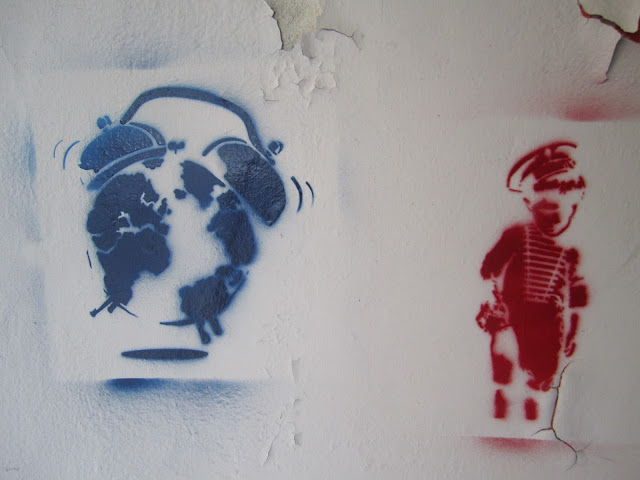
So the clock ticks round and round, twenty-four hours a day, and anything becomes possible at four AM. At seven AM. At midnight, eating supper. You wonder whether you'll bring this clock with you when you go, a clock that's warped and slippery like the ones in Dali's paintings. How long will it take, you wonder, for them to fall from you - these languishing hours of which any interpretation is acceptable? And how long will right now stay off limits? The weeks you have left here stretch before you, but because you are now on this country's time, you know not to count them.


Sunday, October 9, 2011

Forward-thinking, bohemian places


Frank Bruni, in his NYTimes op-ed 'Same-Sex Marriage in Portugal,' does a nice job of exploring the legal status of same-sex marriage around the world, pondering why certain countries (cough cough) choose not to nationally legalize it. It's well worth a read, but if you don't have one of your dwindling twenty to spare, find below an interesting excerpt that mentions Argentina!! (Where gay marriage is nationally legal.)

It was only a little more than a decade ago that a country first legalized same-sex marriage, and that happened in precisely the kind of forward-thinking, bohemian place you’d expect: the Netherlands. About two years later, Belgium followed suit.

Then things got really interesting. The eight countries that later joined the club were a mix of largely foreseeable and less predictable additions. In the first category I’d put Canada, Norway, Sweden and Iceland. In the second: South Africa, Spain, Portugal and Argentina.

Why those four countries? People who have studied the issue note that that they have something interesting and relevant in common: each spent a significant period of the late 20th century governed by a dictatorship or brutally discriminatory government, and each emerged from that determined to exhibit a modernity and concern for human rights that put the past to rest.

Thanks for sending, Sam! Hope you're all having a marvelous Sunday. Love, Kate

Addendum: Sam just told me that if you access a NYTimes article from an outside link, it won't count as one of your twenty!! So read on, my devoted following! Read on. 

Sunday, October 2, 2011

Color in Space and Time

To my dear readership:

A few words on Carlos Cruz-Diez's exhibit, 'El color en el espacio y en el tiempo,' shown at the MALBA, Buenos Aires, 2011

Carlos Cruz-Diez makes art you have to enter. He makes sculpture-paintings you must move around to see fully; with the slightest shift, the barest breath, the surface changes, and  sometimes it even slides right into the opposite of itself. 


I discovered Cruz Diez last weekend at the MALBA Museum’s tenth anniversary celebration. The MALBA, one of BA’s largest and most-respected museums, mirrors both the architecture and content of the Whitney in New York: high ceilings and a blocky, triangular exterior, and highly experimental exhibitions of modern art inside. Buenos Aires and New York remind me of each other as well, so that similarity could be reinforcing my comparison. In any case, how good it felt to be in that fine museum, which felt to me so reminiscent of those contemporary galleries in New York and Boston that I’ve been missing.

The MALBA presented an excellent series entitled ‘Art in Latin America: 1990-2010,’ which I admired for the incredible, exhaustive portrait created by this curator—but there were crowds, how could there not have been, on a glorious BA weekend….and I couldn’t really breathe in there, let alone stand and look. So I’m taking Sam there when she comes—on a weekday, and meanwhile, I let Cruz-Diez’s quieter show upstairs pull me under.

Cruz-Diez’s exhibit presented some of his earliest drawings and watercolors, which echo the tiny points and blocky, emotive patches of color employed by the later European Impressionists. Yet the ‘painting-sculptures’ that quickly followed those drawings are made of slats of painted wood glued to canvases. They show how fast this artist shifted from both literal expression and the limits of a two-dimensional surface. The sculptures, at first reminiscent of Piet Mondrian’s paintings of white lines and squares of color, morph within two years into luminous, shapeshifting surfaces that engage without employing anything literal.


From a few slats of wood on a canvas, Cruz-Diez moved into a process which involved laying, centimeters apart, dozens or hundreds of paper-thin slats horizontally. By varying the colors of the geometrical shapes on the canvas, as well as the colors on the slats themselves, Cruz-Diez made the works—the ‘sculpture-paintings’—different depending on where the viewer is positioned. He made it necessary that the viewer move in and out of the canvas to see the 'whole'. The effect is a work that shifts and shimmers as you pass it, drawing you in to inspect and then asking that you step back and take in the whole. These pieces are made to take time.


Self-defined as a ‘kinetic’ artist, Cruz-Diez finally moves beyond the canvas altogether; at the end of his MALBA exhibition, viewers are invited to slip gauzy hair-nets over their shoes and enter an all-white room: white floors, white ceilings, and white walls. Except that nothing is really white; the gallery is cordoned off by half-walls, and each ‘half-room’ exudes a color. Light is the medium here, light and white walls. An all-pink room envelops you, the pink, boxed bulb in the center of the room radiating more the heat of the pink than the light of it. A similar blue room induces melancholy, and a green room invigorates. At least, these were my impressions; each colored room absorbed me, completely shifting, albeit momentarily, how I felt. It was an amazing end to a truly powerful exhibit, one where I entered so many rooms, shifted between so many dimensions and so many times of day. It was a Rothko-like immersion, that all-absorbing color, except in this case the light was literal.


Cruz-Diez was born in Caracas in 1923. He’s divided his time between Mexico and France since 1960, and has exhibited extensively on both those continents.  I encourage you to see his works up close if you’re ever given the chance, and I’ll leave you, my dear readership, with this excerpt from Mari Carmen Ramirez’s essay, “The Issue At Stake is Color,” as printed in MALBA’s write-up, ‘Carlos Cruz-Diez: El color en el espacio y en el tiempo.’

Cruz-Diez immerses us in unprecedented situations—what he calls ‘événements,’ or events—in which color happens, becoming several things at once; an unsuspected dimension of space; an unrestrained, real-time experience; and an essential means for reconditioning and stimulating our senses.

Portrait of the artist (daylife.com)

Saturday, October 1, 2011

Reaching Esquel

for Paul

There's been an absence of actual writing on my blog, and that's because I've been struggling with what to say about Patagonia. It’s not that I don’t want to share things with my beloved readership, for Patagonia was incredible; it’s that I've been afraid, because I know that a post about reaching Patagonia won't be like any other post.

Esquel, a small city four hours south (by bus) of Bariloche, was the last city Paul reached. The Old Patagonian Express, literally, brought him there on rickety tracks. I, on the other hand, flew into the tiny Esquel airport from Buenos Aires with my father and brother. And although we took a twenty-two hour bus ride back to Buenos Aires, and although there have been times when Paul has flown and I have ridden many hours over dirt roads, I still feel a twinge, knowing I wasn't on that last train. 

It’s how I began eleven months ago; flying into Guatemala City, though Paul had taken the train. Esquel happened so fast; the wheels touched down and then the desert was everywhere. There was the rush of pictures we snapped, standing in the wild airport wind, and the air traffic controller who ushered us on. The purple gray of ash, the ribbons of loose, brick-red stone, and the blotted blue of the enormous sky. The same snowy strip of peaks Paul gazed at. That was all, and then we were hustled away.

Paul described it like this: “Ahead,” he wrote, “there was a succession of hills, whittled and fissured by the wind, which now sang in the bushes. The bushes shook with this song. They stiffened again and were silent.”

*

Although his book was, in part, the inspiration for my year in Latin America, Paul and I are not connected in the way I’d imagined we would be, having followed his route for so long. I now realize we’ve had different goals and different means, and in forty years so much can change. I think I just kept waiting, as I made my way down and compared my experiences to Paul's, for some epiphany, some moment when he felt and saw exactly what I felt and saw, but that never came and I know now that I shouldn't be surprised. A man’s experience traveling solo will always differ drastically from a woman's, but beyond that, Paul and I consistently made different choices about places, and took away such different impressions. We are different people, and that helps me to feel less sorry for missing the particular Patagonian silence he described.

Anyway, haven't I known other silence? Haven't I listened alone to the wind, the way it shifts and pauses, so many times? And didn't I always know that I could never travel the way he did, fast through every town and forest, and over, without stopping, every peak? His relationships were fleeting ones (well, with a few admittedly notable exceptions, and a nod to Borges). Paul never entered a rural school on his way to Patagonia; he never walked a dirt road to a mountain town. 

So hadn't I better ask myself, instead, what Mary Elvira Stevens would have wanted? What would have mattered most to her? The fellowship's parameters state that "preference shall be given to persons with good temper and a natural generosity of view when confronted with alien conditions, common sense in observing and comprehending social, economic, and political situations, a strong desire to travel, and a deep love of beauty."

Have you done your best to keep your cool? Mary might have asked me. I imagine she was a woman with a little glimmer in her eye, a little streak of wildness behind the put-together, old-school Wellesley exterior. Have you shown common sense? And I would admit to her that I have, almost always. I think she'd understand that. Have you wondered, have you explored? She’d ask, a smile playing at the edge of her mouth. Have you read, have you learned?

And I would tell her in reply that this year, I’ve opened so many doors. I have laughed and wept to extremes. So many things have caught my breath; so many nights I’ve spent alone. But above all that, I’ve been so lucky, I would tell her, to have fallen in love so many times, with so many streets and forests and markets, and with so many people. I've seen so much beauty, I can promise Mary that, and I can only hope, now, that some of that graces the page.

As I’ve written before, the year’s not over. My life, for now, is in Buenos Aires, where rain beats on the roof in the night, turning the grass in the morning green. It’s a city of trees on the sidewalks: weeping willows in Palermo and the ten-story-high jacarandas that line my Barracas street. The light, now that it's springtime, seems always to be luminous, ethereal and muted through the leaves. In the evening the cobblestones look golden. I try not to count the days I have left, but instead to wrap the city around me. Walking the streets, I'm a breath and nothing more. I feel almost wild with freedom, and my sleep runs thick with dreams.

*

So thank you, Paul, for your map and your book. Thanks for reminding me there are trails across continents, and that sooner or later, you can get almost anywhere. I hope our routes cross again someday, and I wish you the best, wherever on this planet you are.

I’ll end these musings, for now, with a quote I am shamelessly stealing from Christine’s blog. The following comes from Jhumpa Lahiri’s 1999 short-story collection, The Interpreter of Maladies.

“Still, there are times I am bewildered by each mile I have traveled, each meal I have eaten, each person I have known, each room in which I have slept. As ordinary as it all appears, there are times when it is beyond my imagination.”


Friday, September 23, 2011

Seeing Bariloche

Dear, dear ones,

I made it to Esquel, did you know that? Paul didn't go any father than that, and so, in a way, the journey's over. I thought I'd cry when I reached the end, but my brother David was right beside me, and he made me laugh instead. I flew there, Paul - there was no train. In my defense, we bussed it back to Buenos Aires - 22 hours through the Pampas. That's something, right? I say it is.

So we made it to Esquel, that wind-whipped place, where the airport crammed in everyone en route to Bariloche. The erupting volcano in Chile has kept the Bariloche airport closed for months now, and the air all over remains ashy, hazy. Everything - the plains, the woods, the lakes - hold the tint of that ash, which fell like snow by the meter, and which continues to fall even now. It's crippled the economy there, que pena, but go anyway, if you can. God, it was so beautiful.

So I have seen Patagonia now. I've been trying for days to write something about it for you all, but all that comes out are these long (too long for this blog!) essays about being with my dad, and being with Dave, and feeling so at home in that place of cedars and mountains and lakes.

So for now I'll leave Paul's words up (below), because he said it best. It's been the journey all along, hasn't it? And I'm still down here, so I guess that means it's not over yet.

Meanwhile, may you all enjoy amazing Bariloche...


 Oh yes, that's some succulent pow right there! Except I am officially old, because it was deep and steep and I got scared. I skiied better when I was twelve. It's sad.

But wait...it doesn't matter how you ski, right? It matters how you look, on and off the hill! We can all thank Guy Middleton for that one.

And we can thank the Church of the Great Blue Dome for these: 


Finally, yum. This was taken at the Cerro Catedral, in San Martin de los Andes:

Eat your heart out, Big Fellas!

Love, Kate

Thursday, September 22, 2011

Patagonian Roads

The Patagonian paradox was this: to be here, it helped to be a miniaturist, or else interested in enormous empty spaces. There was no intermediate zone of study. Either the enormity of the desert space, or the sight of a tiny flower. You had to choose between the tiny or the vast.

The paradox diverted me. My arrival did not matter. It was the journey that counted.

Paul Theroux, The Old Patagonian Express